The following is an actual account of an insurance agent's interaction with several clients over the last year. (Not me of course)
Agent: So Mr. K, here is your quote and here is what it covers. When would you like for the policy to start?
Mr. K: Everything looks good. I'm just going to run it by my wife first. (Classic excuse for shifting blame to wife)
Agent follows up a day later......
Agent: Mr. K, let's get this policy going.
Mr. K: Well my friend, my wife said no. She said that I've been in business for 20 years without insurance and don't need it now.
Agent: Well, then you just call me right before you have a claim then. Have a nice day!
OR THIS IS ANOTHER CLASSIC MISCONCEPTION THAT'S FLOATING AROUND
"I don't need insurance because I'm a corporation, not a sole prop, so my personal assets are protected. THAT'S HILARIOUS! I don't know who started that rumor, but they deserve to be slapped. YES, YOU ARE LIABLE FOR ANY THIRD PARTY YOU DO BUSINESS WITH. IT DOES NOT MATTER HOW YOUR BUSINESS IS FORMED OR TITLED.
Unless you're Grace the Psychic Lady or Walter Mercado, you're not going to know when a claim will be filed. In fact, chances are you'll never have one. But, there's still a chance. And do you want to risk everything you've worked hard for because you weren't protected? Take my office for example: About a year ago, I had a client who wrote me a hot check almost start a fight with me because I wouldn't do business with him!!!! WITH ME! I don't know what's crazier: The fact that he was surprised that I wouldn't do business with him or the fact that he wanted to go toe to toe. And guess what? If I would have unleashed, then it would have been a claim on my business policy. That't right. I would have a claim to file for medical expenses and any lawsuit that idiot would have brought. The world is a crazy place.
So, here's my bit of unsolicited advice for today: Get insurance. You never know what the day might bring, especially if your business involves people.
Stay protected my friends.

We are El Paso's insurance blog. We'll cover everything from issues to trends, bonds to sr22s. Please send us topics you'd like to discuss!
Thursday, May 31, 2012

Wednesday, May 23, 2012
General Liab vs Professional Liab......FIGHT!
Think you're covered with that General liability policy?? Maybe not. Read this great article below on the differences, and why you may not be covered with that GL you have.
The following was taken from:
http://ezinearticles.com/?Professional-Liability-Insurance-Vs-General-Liability-Insurance&id=1421574
Intrinsically, insurance is based on the principles of protecting a person or business from particular risks. This can include anything from natural disasters to theft to property damage.
Yet, when it comes to business, the kinds of risk can be far more significant, as well as far more costly. Not only are you responsible for what happens to your own property and employees, but you're also responsible to the people with whom your business comes in contact. General liability insurance covers these risks and protects your company from possible adverse financial situations. Professional liability insurance also covers those same risks, but is more specific to certain professional fields.
The Concern of Liability
Liability is a concern for businesses because a business is responsible not only for harm and damages done as a direct consequence of doing business, but also as an indirect consequence of doing business.
This, unfortunately, entails a wide selection of possibilities. A mistake made months or years ago by you or your employees could have caused harm to someone by a third party using your product or service. Regrettably, it's nearly impossible to predict everything that may happen as a result of your business services or products. Professional liability insurance and general liability insurance are thus critical in protecting your interests and the interests of your company. Otherwise, the risks of putting yourself and your business in serious financial jeopardy are limitless.
The Differences
General liability insurance and professional liability insurance are like two sides of a coin. Whether it's personal, business, or corporate insurance, insurance packages and providers envelop a range of different facets for individuals and groups of individuals. Though the boundary is sometimes blurred between the diverse insurance coverage provided by either general liability or professional liability insurance, there are surely differences between the two.
Ultimately, the differences between general liability insurance and professional liability insurance put them in different categories, which include business insurance, and general insurance. Knowing the disparities and acquiring the most suitable insurance is a critical move for your company. Insurance should always be an integral part of your business.
Policies considered general liability insurance typically address claims of bodily injury or property damage liability. Most companies are already familiar with general liability coverage including: injury, environmental impact, casualty, and more of the like.
Professional liability insurance differs in that it pertains to negligence associated with your professional services. The damage is typically financial, rather than physical. Accordingly, a professional such as an accountant would be expected to perform in a certain manner and abide by a set code of conduct. Violating those principles could hold the accountant responsible for harm or damages done to others. A management consultant may have a different set of professional expectations to abide by. Both professionals must stand by their particular professional standards, or could be subject to liability suits and resulting damages.
As with general liability insurance, professional liability insurance is crucial because it covers the indirect consequences of your conduct. Even a phone conversation with a third party advising them on how to deal with one of their own clients can leave you liable for your conduct. Consequently, professionals always need to practice the utmost care when carrying out their duties. In order to be vigilantly careful, it's important to have the appropriate general liability insurance, and the proper professional liability insurance that may save you from financial harm.
Article Source: http://EzineArticles.com/1421574
Please give us a call to discuss your professional liability needs.....Everything from medical malpractice to Law Firm Professional Liability. Stay protected my friends!!
The following was taken from:
http://ezinearticles.com/?Professional-Liability-Insurance-Vs-General-Liability-Insurance&id=1421574
Intrinsically, insurance is based on the principles of protecting a person or business from particular risks. This can include anything from natural disasters to theft to property damage.
Yet, when it comes to business, the kinds of risk can be far more significant, as well as far more costly. Not only are you responsible for what happens to your own property and employees, but you're also responsible to the people with whom your business comes in contact. General liability insurance covers these risks and protects your company from possible adverse financial situations. Professional liability insurance also covers those same risks, but is more specific to certain professional fields.
The Concern of Liability
Liability is a concern for businesses because a business is responsible not only for harm and damages done as a direct consequence of doing business, but also as an indirect consequence of doing business.
This, unfortunately, entails a wide selection of possibilities. A mistake made months or years ago by you or your employees could have caused harm to someone by a third party using your product or service. Regrettably, it's nearly impossible to predict everything that may happen as a result of your business services or products. Professional liability insurance and general liability insurance are thus critical in protecting your interests and the interests of your company. Otherwise, the risks of putting yourself and your business in serious financial jeopardy are limitless.
The Differences
General liability insurance and professional liability insurance are like two sides of a coin. Whether it's personal, business, or corporate insurance, insurance packages and providers envelop a range of different facets for individuals and groups of individuals. Though the boundary is sometimes blurred between the diverse insurance coverage provided by either general liability or professional liability insurance, there are surely differences between the two.
Ultimately, the differences between general liability insurance and professional liability insurance put them in different categories, which include business insurance, and general insurance. Knowing the disparities and acquiring the most suitable insurance is a critical move for your company. Insurance should always be an integral part of your business.
Policies considered general liability insurance typically address claims of bodily injury or property damage liability. Most companies are already familiar with general liability coverage including: injury, environmental impact, casualty, and more of the like.
Professional liability insurance differs in that it pertains to negligence associated with your professional services. The damage is typically financial, rather than physical. Accordingly, a professional such as an accountant would be expected to perform in a certain manner and abide by a set code of conduct. Violating those principles could hold the accountant responsible for harm or damages done to others. A management consultant may have a different set of professional expectations to abide by. Both professionals must stand by their particular professional standards, or could be subject to liability suits and resulting damages.
As with general liability insurance, professional liability insurance is crucial because it covers the indirect consequences of your conduct. Even a phone conversation with a third party advising them on how to deal with one of their own clients can leave you liable for your conduct. Consequently, professionals always need to practice the utmost care when carrying out their duties. In order to be vigilantly careful, it's important to have the appropriate general liability insurance, and the proper professional liability insurance that may save you from financial harm.
Article Source: http://EzineArticles.com/1421574
Please give us a call to discuss your professional liability needs.....Everything from medical malpractice to Law Firm Professional Liability. Stay protected my friends!!
Tuesday, May 22, 2012
Makin' it rain
Well, if you were a client, you could be making it rain too with all that cash you would be saving. Wanna hear some recent success stories?
- Saved a local restaurant 4k and provided better coverage
- Got numerous contractors approved for a blanket bond so now they can DO WORK
- Saved numerous HVAC contractors a few thousand with BETTER coverage
- Insured a NEW VENTURE trucking operation, so they can supply the paper to make it rain
Friday, May 18, 2012
Alameda, botas el malcreado, and car lots
Dealer Open Lot Insurance
Dealer Open Lot insurance provides physical damage coverage protection to a dealer’s covered autos and equipment. Covered Autos are typically private passenger vehicles (autos, pickups, minivans, SUV’s, etc.), RV units and other autos that are in the dealer’s inventory and held for sale. The vehicles may be used, new, demonstrators or service vehicles. Most insurance companies who write dealer open lot coverage require that the total value of the inventory be insured to 100% of their value.Maximum Dealer’s Open Lot limits vary by state and range from $500,000 to $1,000,000 or more. The Per Vehicle limit available is $150,000.
Beyond inventory coverage, dealers may choose coverage that addresses specific needs. Have the piece of mind of knowing exactly what your dealership's policy covers. Listed below are additional dealer coverages you may choose.
Open Lot Coverage
What coverage do you have? We have found that many used car dealers purchased a state minimum garage liability policy when starting out in the car business. Although these policies meet the dealer license requirement, many dealers have outgrown these policies.Beyond the state required minimums many dealers may consider additional coverage to protect their assets.
• Vehicle Inventory
• Business Property
• Workers Comp
• Specified Causes (Fire, Hail, Vandalism, Transport)
• False Pretense
• Tow Trucks
• Errors and Omissions (Titles, Odometer, Truth in Lending)
• Uninsured Motorists
• Fire and Theft
Surprisingly, MANY dealerships in El Paso don't even carry Garage Liability, the bare minimum required by law. If you know a car dealer, send them my way! I'll throw in a pair of picudas from El Malcreado to sweeten the deal. Stay protected my friends!!!
Tuesday, May 15, 2012
Give me one reason why...
Need a reason why to get life insurance? Here are 26.
Give me a call today to get protected. You can afford to protect your family, business, or whatever else you need to fund. You can't afford not to. 915-313-44691. They do not want to pass on their financial obligations or their funeral costs to their families.2. They want to supplement their Social Security benefits so that during their retirement years, their standard of living will not be drastically lowered.3. They don't want to die and leave only enough life insurance and other assets to pay off their last expenses, so that their families will not have enough money to last through the financial -adjustment period that follows the death of the breadwinner.4. They want to supplement their Social Security death benefits so that their surviving families will continue to maintain their standard of living.5. They know that life insurance can guarantee a fixed income for a surviving parent who must remain at home to care for children.6. They need an adequate guaranteed retirement income.7. They need a plan with a definite goal, one that does not depend on speculation and self-control.8. They have purchased a home and want to be sure that it will remain in their family even if they are not there to meet the monthly mortgage payments.9. They want to see their children go to college.10. They want to start protection and thrift programs for their children while the children are young, because they have learned that age provides the only bargain in life insurance.11. They want to solve the basic needs of protection for members of their family.12. They know that a mother's death can be as financially disabling as a father's death.13. They want to leave resources for special reasons: giving gifts and bequests, contributing to a son's or daughter's wedding, funding for a son's or daughter's own business, or providing for a disabled or disadvantaged child.14. They have recently married.15. They have become new parents.16. They have a new job or received a promotion, which has increased their financial value and their ability to afford adequate insurance protection.17. They are recent college graduates-marking the beginning of their financial independence.18. They are business owners who need to protect key employees.19. They need to enhance their business credit standings.20. They are sole proprietors who need to protect their business for their survivors.2 1. They are involved in a partnership that needs to be protected from being shared by a partner's disinterested survivor.22. They need a method to liquidate stockholder's interests.23. They need a method to fund buy-sell agreements.24. They need a method to fund pension plans.25. They want to prepare for retirement by combining guaranteed income and growth possibilities of equities.26. They have certain tax problems that need to be solved.
Friday, May 11, 2012
Look'em in the eye
Does it bug you when people don't look you in the eye? It bugs the absolute HELL out of me. The following is from the website: http://artofmanliness.com/2012/02/05/look-em-in-the-eye-part-i-the-importance-of-eye-contact/
If you've never visited this website, I encourage you to do so. And, look'em in the eye.
How often have you talked with another guy who never looked you in the eye during the entire length of the conversation? Or perhaps he did meet your gaze a few times, but then his eyes shifted back to his shoes or to some point off in the distance.
I’d like to say that the ability to make good eye contact is one of the social skills a lot of young men seem to be struggling with these days, which would be true, but I’ve encountered enough gaze-averting middle-aged men to know that it’s a multi-generational problem. And actually, it’s probably something men have always struggled with—females are on average better at making and holding eye contact than males, and in fact, it’s been found that the higher the levels of testosterone a fetus is exposed to in utero, the less eye contact they make as infants—across genders. Interestingly, the exception to this rule are male babies who have the very highest levels of T; they end up being as adept at eye contact as their female counterparts—alpha babies aren’t afraid to look you in the eye!
But just because making eye contact doesn’t come naturally to us men, doesn’t mean you should just shrug your shoulders and accept this predisposition. The ability to make high-level eye contact is a skill every man should work on, as it has been shown to create some incredible benefits for the gazer. Numerous studies have shown that people who make higher-levels of eye contact with others are perceived as being:
In short, making greater eye contact with others can increase the quality of all of your face-to-face interactions; there’s no area of your life where being seen as more attractive, confident, and trustworthy wouldn’t be a boon. Being able to look people in the eye and hold their gaze can help you better network with others, land a job, pitch an idea, make a moving speech, woo the ladies, and intimidate your enemies. It can help a lawyer win over a jury, a boxer psych out his opponent, and a minister connect with his congregants. It can even aid a musician in winning over new fans; studies have shown that the more eye contact a musician makes with his audience, the more they enjoy his music—take note ye members of struggling bands!
And the best part of all this is that improving your eye contact is something you can do relatively quickly and easily. Next week in the second article of this two-part series, we’ll cover all the practical nuts and bolts on how to do that, and offer some really helpful eye contact tips for both general conversational situations as well as specific scenarios.
But today we’d like to begin with an exploration of why making eye contact is so important in forming relationships with other people, and why it can be so hard to do.
1. Our eyes were made to connect. It’s easy to see why the eyes of others capture our gaze: they’re free-moving orbs lodged in an otherwise stationary face; eyeballs are really kind of weird when you think about them, aren’t they? But they also grab our attention for a reason that is distinctly human. While our irises and pupils float on a bright white canvas, none of the other 220 species of primates have white in their eyes at all, or at least whites that can readily be seen.
The whites of our eyes make it very easy for others to see exactly what we’re looking at and notice when our focus changes direction. While primates will typically turn their gaze in the direction a person points his whole head towards, a human infant is more likely to follow the person’s eyes, regardless of which way the person’s head is tilted. Anthropologists think our uniquely human eyes evolved to help us achieve a greater level of cooperation with others, which is helpful in survival and building a civilization. All of which is to say: your eyes were made to communicate with the eyes of other people.
2. Our eyes reveal our thoughts and feelings. You’ve probably heard the old expression: “The eyes are the window to the soul.” While that may not be literally true, they do reveal a great deal about what we’re really thinking and feeling from moment to moment.
Think of all the eye-related expressions we have in our language. We’re seduced by “bedroom eyes,” wary of “shifty eyes,” and afraid of getting the “evil eye.” We’re attracted to people who have “kind eyes” and eyes that “sparkle,” “glow,” or “twinkle,” while we’re repelled by those who are “dead behind the eyes.” When someone is eager and peppy we say they’re “bright-eyed;” when they’re bored we describe their eyes as “glazed over.” Love stories in both fiction and real life very often begin with two pairs of eyes meeting across a room. And Bryan Adams says you can gauge your love for a woman from your ability to see your unborn children in her eyes! Kind of romantic, kind of creepy.
That we give so much credence to the idea that we can read someone from what’s in their eyes is due to the fact that even when we hide what we’re really thinking and feeling in our body language and facial expressions, it’s often still revealed in our eyes. “The eyes don’t lie” as people say (although good liars can, in reality, get their eyes to fib for them). This is why poker players often wear sunglasses in order to disguise their reactions to the hands they’re dealt.
The human propensity to look to someone’s eyes in order to decipher what they’re thinking starts very early in life. Around 9-18 months, infants will begin to look to their parents’ eyes to figure out what they’re trying to convey when their face is otherwise ambiguous. And we continue to do this for the rest of our lives.
Finally, we lend a lot of weight to eye contact in our interactions because it’s a form of simultaneous communication. You don’t have to take turns expressing yourselves as you do with talking. If you’ve ever had a whole mini conversation across the room with your spouse, using only your eyes, you know how this works.
3. Eye contact shows attention. Sociologists tell us that people are starved for attention these days. Despite the fact that we’re more “connected” than ever, folks are hungry for face-to-face interactions and someone to really, sincerely listen to them. This hunger for attention can manifest itself in things like “conversational narcissism.” And if you read our discussion about that social malady from awhile back, you’ll remember that we talked about how you show your attention to someone with whom you are talking by using “support-responses,” such as nodding your head and offering “background acknowledgments” like “mmm’s” and “yeah’s.” Well, eye contact is another form of background acknowledgement—and a very important one at that. It shows the speaker that you’re tuned in to what he’s saying. Think of how crappy you feel when you’re talking with someone and he’s looking all around the room for someone else to ditch you for.
The ability to give eye contact to someone as they speak is an especially powerful tool these days; it has become so common for people to break their gaze to check their phone during a conversation, that giving someone your complete and undivided attention can truly win them over.
4. Eye contact creates an intimate bond. When I am performing a task or feeling an emotion, and you are observing me do so, the same neurons that are being lit up in my brain by actually having the experience, are the ones that light up in your brain just from watching me. This is made possible by the presence of “mirror neurons” in our craniums. And the activation of these mirror neurons is especially sensitive to facial expressions, and, you guessed it, eye contact. Have you ever been hit hard with an emotion after looking into the eyes of someone who was experiencing it? Eye contact creates moments where you are able to really feel what someone else is feeling. It links together your emotional states and creates empathy and an intimate bond.
This is why when we’re interacting as disembodied selves on the internet, it can be very easy to be angry and hateful to people, but when you see someone face-to-face, and look into their eyes, you often can get a sense of their humanity and your anger greatly dissipates.
Getting in-sync with others, sharing our feelings, showing attention, creating a bond: eye contact is truly a powerful tool for connecting with others.
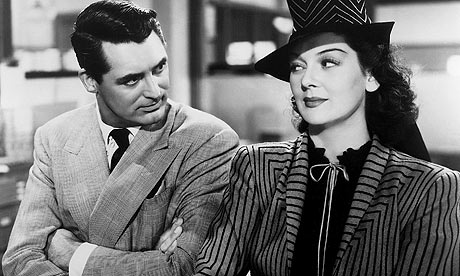
But on the other hand…getting in-sync with others, sharing our feelings, showing attention, creating a bond…these things aren’t easy—especially for men!
While people like to see our eyes so they can get a handle on what we’re really thinking and feeling, from our side of things, revealing what’s going on inside our heads can make us feel very vulnerable. We avoid eye contact when we don’t want people to take a closer look at us and see more of who we are. This reticence can be rooted in several causes:
Hiding deceit. If you’re purposefully hiding the truth from someone, you may hesitate to look them in the eye because you’re worried that your eyes will give away the truth, and because creating the kind of intimate bond described above when you’re knowingly duping someone makes you feel especially ashamed. This is why people will sometimes, although not always, avoid your gaze when they’re lying to you, why people say things like: “Look me in the eye when you tell me that!” and why people who do make solid eye contact are considered more trustworthy.
Masking emotions. There are times when you’re not trying to disguise a lie outright, but simply wish to conceal your true feelings from others, such as when you do not think your reaction to something will be received favorably by them. Anger, fear, and surprise are the emotions that register most through our eyes, and are hardest to hide. And they’re also the emotions we most often want to keep from others.
Insecurity. Finally, one of the most common reasons that people avoid eye contact is from simple insecurity. Eye contact invites more interaction, and you might not want people to take a closer look at you because of how you feel about yourself.
People with higher-status make more eye contact when they’re speaking to others, while those who feel they are of lower-status will make less eye contact and be the first to avert their gaze. When a guy can’t look anyone in the eye when he’s speaking to them, it’s often because he doesn’t feel like he comes up to anyone’s level; he doesn’t believe he can hold his own with other people.
This lack of confidence can be rooted in insecurity over one’s physical appearance, or the state of one’s mind. A study was done where college students were shown faces which looked at the participants with different kinds of gazes—averted or direct. The students then ranked the faces on whether they seemed approachable or avoidable. Then a survey was given to the participants that evaluated their mental health. The students who ranked the faces that had a direct gaze as approachable were found to be more emotionally stable than those who found the direct gaze faces avoidable. Another study specifically showed that people who suffer from depression—which can do a number on a person’s self-confidence–are less likely to make eye contact with people.
People will also avoid eye contact when saying a sarcastic, as opposed to a sincere, comment, as sarcasm is often used by those who are too insecure to show aggression or state their opinion directly.
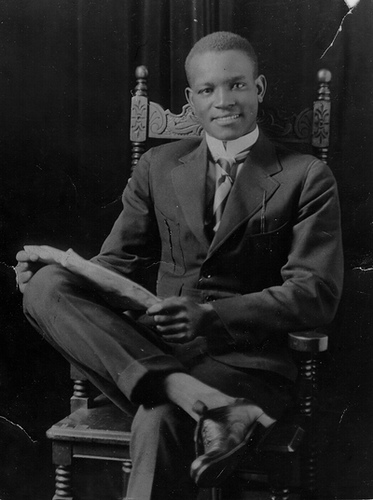
The common denominator in all three of the above reasons for avoiding eye contact is the fear of rejection. If eyes are the portals to our feelings and thoughts, eye contact acts as an intimacy regulator. The more eye contact you make, the more you put yourself out there. Thus the more confidence you have in what people will find once they get a closer look at you and peer into the chamber of your heart, the more comfortable you feel with looking them in the eye. And conversely, the more shame you feel about what others will discover when you open up to them, the more likely you are to avert your gaze.
As I mentioned, next week we’ll get into the practical nuts and bolts of how to make eye contact in the right way. But it should be obvious from this introduction that no amount of external fine tuning of your gaze can compensate for unresolved internal issues that need fixing. You can force yourself to make eye contact with people even when you don’t feel like it, but good eye contact is not just about quantity, it’s about quality. While it may not be true that the eyes are the window of the soul, in my opinion there really is something almost metaphysical about the way in which our character becomes etched upon them. People with kind eyes are almost invariably kind people. People with a twinkle in their eyes are almost always possessed with an enviable vitality. And those with dead eyes on the outside, tend to be dead on the inside, too.
Thus the foundation of good eye contact truly comes from within (changing your outer appearance by doing things like losing weight and dressing your best helps too, but even these things typically require a change of inner attitude). The more you live a life of integrity, the easier it will be to look everyone you meet in the eye, and do it with confidence and a real smile.
Note: The principles in this series are written for men who live in Western countries. The importance of eye contact and how to make it can vary from culture to culture.
Sources:
The Power of Eye Contact: Your Secret for Success in Business, Love, and Life by Michael EllsbergThe Persuasion Handbook: Developments in Theory and Practice by James Price Dillard, Michael PfauApplied Organizational Communication: Theory and Practice by Thomas E. Harris, Thomas E. Harris, and Mark D. NelsonNonverbal Communication by Albert MehrabianStatus and Groups by Melissa Thomas-Hunt
If you've never visited this website, I encourage you to do so. And, look'em in the eye.
How often have you talked with another guy who never looked you in the eye during the entire length of the conversation? Or perhaps he did meet your gaze a few times, but then his eyes shifted back to his shoes or to some point off in the distance.
I’d like to say that the ability to make good eye contact is one of the social skills a lot of young men seem to be struggling with these days, which would be true, but I’ve encountered enough gaze-averting middle-aged men to know that it’s a multi-generational problem. And actually, it’s probably something men have always struggled with—females are on average better at making and holding eye contact than males, and in fact, it’s been found that the higher the levels of testosterone a fetus is exposed to in utero, the less eye contact they make as infants—across genders. Interestingly, the exception to this rule are male babies who have the very highest levels of T; they end up being as adept at eye contact as their female counterparts—alpha babies aren’t afraid to look you in the eye!
But just because making eye contact doesn’t come naturally to us men, doesn’t mean you should just shrug your shoulders and accept this predisposition. The ability to make high-level eye contact is a skill every man should work on, as it has been shown to create some incredible benefits for the gazer. Numerous studies have shown that people who make higher-levels of eye contact with others are perceived as being:
- More dominant and powerful
- More warm and personable
- More attractive and likeable
- More qualified, skilled, competent, and valuable
- More trustworthy, honest, and sincere
- More confident and emotionally stable
In short, making greater eye contact with others can increase the quality of all of your face-to-face interactions; there’s no area of your life where being seen as more attractive, confident, and trustworthy wouldn’t be a boon. Being able to look people in the eye and hold their gaze can help you better network with others, land a job, pitch an idea, make a moving speech, woo the ladies, and intimidate your enemies. It can help a lawyer win over a jury, a boxer psych out his opponent, and a minister connect with his congregants. It can even aid a musician in winning over new fans; studies have shown that the more eye contact a musician makes with his audience, the more they enjoy his music—take note ye members of struggling bands!
And the best part of all this is that improving your eye contact is something you can do relatively quickly and easily. Next week in the second article of this two-part series, we’ll cover all the practical nuts and bolts on how to do that, and offer some really helpful eye contact tips for both general conversational situations as well as specific scenarios.
But today we’d like to begin with an exploration of why making eye contact is so important in forming relationships with other people, and why it can be so hard to do.
Why Eye Contact Is Vitally Important for Creating Positive Connections with Others
Why does making eye contact with people have such a dramatic effect in improving their perception of you? There are four main reasons:1. Our eyes were made to connect. It’s easy to see why the eyes of others capture our gaze: they’re free-moving orbs lodged in an otherwise stationary face; eyeballs are really kind of weird when you think about them, aren’t they? But they also grab our attention for a reason that is distinctly human. While our irises and pupils float on a bright white canvas, none of the other 220 species of primates have white in their eyes at all, or at least whites that can readily be seen.
The whites of our eyes make it very easy for others to see exactly what we’re looking at and notice when our focus changes direction. While primates will typically turn their gaze in the direction a person points his whole head towards, a human infant is more likely to follow the person’s eyes, regardless of which way the person’s head is tilted. Anthropologists think our uniquely human eyes evolved to help us achieve a greater level of cooperation with others, which is helpful in survival and building a civilization. All of which is to say: your eyes were made to communicate with the eyes of other people.
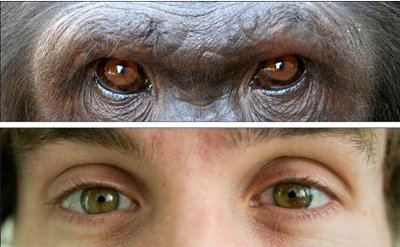
2. Our eyes reveal our thoughts and feelings. You’ve probably heard the old expression: “The eyes are the window to the soul.” While that may not be literally true, they do reveal a great deal about what we’re really thinking and feeling from moment to moment.
Think of all the eye-related expressions we have in our language. We’re seduced by “bedroom eyes,” wary of “shifty eyes,” and afraid of getting the “evil eye.” We’re attracted to people who have “kind eyes” and eyes that “sparkle,” “glow,” or “twinkle,” while we’re repelled by those who are “dead behind the eyes.” When someone is eager and peppy we say they’re “bright-eyed;” when they’re bored we describe their eyes as “glazed over.” Love stories in both fiction and real life very often begin with two pairs of eyes meeting across a room. And Bryan Adams says you can gauge your love for a woman from your ability to see your unborn children in her eyes! Kind of romantic, kind of creepy.
That we give so much credence to the idea that we can read someone from what’s in their eyes is due to the fact that even when we hide what we’re really thinking and feeling in our body language and facial expressions, it’s often still revealed in our eyes. “The eyes don’t lie” as people say (although good liars can, in reality, get their eyes to fib for them). This is why poker players often wear sunglasses in order to disguise their reactions to the hands they’re dealt.
The human propensity to look to someone’s eyes in order to decipher what they’re thinking starts very early in life. Around 9-18 months, infants will begin to look to their parents’ eyes to figure out what they’re trying to convey when their face is otherwise ambiguous. And we continue to do this for the rest of our lives.
Finally, we lend a lot of weight to eye contact in our interactions because it’s a form of simultaneous communication. You don’t have to take turns expressing yourselves as you do with talking. If you’ve ever had a whole mini conversation across the room with your spouse, using only your eyes, you know how this works.
3. Eye contact shows attention. Sociologists tell us that people are starved for attention these days. Despite the fact that we’re more “connected” than ever, folks are hungry for face-to-face interactions and someone to really, sincerely listen to them. This hunger for attention can manifest itself in things like “conversational narcissism.” And if you read our discussion about that social malady from awhile back, you’ll remember that we talked about how you show your attention to someone with whom you are talking by using “support-responses,” such as nodding your head and offering “background acknowledgments” like “mmm’s” and “yeah’s.” Well, eye contact is another form of background acknowledgement—and a very important one at that. It shows the speaker that you’re tuned in to what he’s saying. Think of how crappy you feel when you’re talking with someone and he’s looking all around the room for someone else to ditch you for.
The ability to give eye contact to someone as they speak is an especially powerful tool these days; it has become so common for people to break their gaze to check their phone during a conversation, that giving someone your complete and undivided attention can truly win them over.
4. Eye contact creates an intimate bond. When I am performing a task or feeling an emotion, and you are observing me do so, the same neurons that are being lit up in my brain by actually having the experience, are the ones that light up in your brain just from watching me. This is made possible by the presence of “mirror neurons” in our craniums. And the activation of these mirror neurons is especially sensitive to facial expressions, and, you guessed it, eye contact. Have you ever been hit hard with an emotion after looking into the eyes of someone who was experiencing it? Eye contact creates moments where you are able to really feel what someone else is feeling. It links together your emotional states and creates empathy and an intimate bond.
This is why when we’re interacting as disembodied selves on the internet, it can be very easy to be angry and hateful to people, but when you see someone face-to-face, and look into their eyes, you often can get a sense of their humanity and your anger greatly dissipates.
Getting in-sync with others, sharing our feelings, showing attention, creating a bond: eye contact is truly a powerful tool for connecting with others.
Why Is It So Hard to Make Eye Contact?
But on the other hand…getting in-sync with others, sharing our feelings, showing attention, creating a bond…these things aren’t easy—especially for men!
While people like to see our eyes so they can get a handle on what we’re really thinking and feeling, from our side of things, revealing what’s going on inside our heads can make us feel very vulnerable. We avoid eye contact when we don’t want people to take a closer look at us and see more of who we are. This reticence can be rooted in several causes:
Hiding deceit. If you’re purposefully hiding the truth from someone, you may hesitate to look them in the eye because you’re worried that your eyes will give away the truth, and because creating the kind of intimate bond described above when you’re knowingly duping someone makes you feel especially ashamed. This is why people will sometimes, although not always, avoid your gaze when they’re lying to you, why people say things like: “Look me in the eye when you tell me that!” and why people who do make solid eye contact are considered more trustworthy.
Masking emotions. There are times when you’re not trying to disguise a lie outright, but simply wish to conceal your true feelings from others, such as when you do not think your reaction to something will be received favorably by them. Anger, fear, and surprise are the emotions that register most through our eyes, and are hardest to hide. And they’re also the emotions we most often want to keep from others.
Insecurity. Finally, one of the most common reasons that people avoid eye contact is from simple insecurity. Eye contact invites more interaction, and you might not want people to take a closer look at you because of how you feel about yourself.
People with higher-status make more eye contact when they’re speaking to others, while those who feel they are of lower-status will make less eye contact and be the first to avert their gaze. When a guy can’t look anyone in the eye when he’s speaking to them, it’s often because he doesn’t feel like he comes up to anyone’s level; he doesn’t believe he can hold his own with other people.
This lack of confidence can be rooted in insecurity over one’s physical appearance, or the state of one’s mind. A study was done where college students were shown faces which looked at the participants with different kinds of gazes—averted or direct. The students then ranked the faces on whether they seemed approachable or avoidable. Then a survey was given to the participants that evaluated their mental health. The students who ranked the faces that had a direct gaze as approachable were found to be more emotionally stable than those who found the direct gaze faces avoidable. Another study specifically showed that people who suffer from depression—which can do a number on a person’s self-confidence–are less likely to make eye contact with people.
People will also avoid eye contact when saying a sarcastic, as opposed to a sincere, comment, as sarcasm is often used by those who are too insecure to show aggression or state their opinion directly.
The Best Way to Improve the Quality of Your Eye Contact
The common denominator in all three of the above reasons for avoiding eye contact is the fear of rejection. If eyes are the portals to our feelings and thoughts, eye contact acts as an intimacy regulator. The more eye contact you make, the more you put yourself out there. Thus the more confidence you have in what people will find once they get a closer look at you and peer into the chamber of your heart, the more comfortable you feel with looking them in the eye. And conversely, the more shame you feel about what others will discover when you open up to them, the more likely you are to avert your gaze.
As I mentioned, next week we’ll get into the practical nuts and bolts of how to make eye contact in the right way. But it should be obvious from this introduction that no amount of external fine tuning of your gaze can compensate for unresolved internal issues that need fixing. You can force yourself to make eye contact with people even when you don’t feel like it, but good eye contact is not just about quantity, it’s about quality. While it may not be true that the eyes are the window of the soul, in my opinion there really is something almost metaphysical about the way in which our character becomes etched upon them. People with kind eyes are almost invariably kind people. People with a twinkle in their eyes are almost always possessed with an enviable vitality. And those with dead eyes on the outside, tend to be dead on the inside, too.
Thus the foundation of good eye contact truly comes from within (changing your outer appearance by doing things like losing weight and dressing your best helps too, but even these things typically require a change of inner attitude). The more you live a life of integrity, the easier it will be to look everyone you meet in the eye, and do it with confidence and a real smile.
Note: The principles in this series are written for men who live in Western countries. The importance of eye contact and how to make it can vary from culture to culture.
Sources:
The Power of Eye Contact: Your Secret for Success in Business, Love, and Life by Michael EllsbergThe Persuasion Handbook: Developments in Theory and Practice by James Price Dillard, Michael PfauApplied Organizational Communication: Theory and Practice by Thomas E. Harris, Thomas E. Harris, and Mark D. NelsonNonverbal Communication by Albert MehrabianStatus and Groups by Melissa Thomas-Hunt
Thursday, May 10, 2012
RECYCLERS, This one's for you! Stay protected my friends.

Recycling Centers
Recycling centers are excellent modern business opportunities. Some centers travel around to pick up recyclable materials through a municipality contract. Other recycling centers simply process materials that are brought to them by consumers, groups and individuals. Regardless of which approach you use for your business, carrying the right types of business insurance protection is critical to its success.General Liability
General liability is a broad level of business insurance that helps protect your customers at the same time it protects your recycling centers. This insurance is designed to help prevent your company from suffering massive financial losses when accidents happen or lawsuits arise. General liability grows with your company so that when you add new recycling center locations they’re automatically covered from the start.
General Liability Insurance Includes:
- Premises Liability - Premises liability coverage is particularly important for recycling centers that allow drop offs by customers. If a customer or other person is injured while they’re on your business premises, they may sue your company for the medical and recovery bills they incur because of the accident. Premises liability can pay those bills so that your company does not have to.
- Products Liability - Products liability protects your recycling center when you sell products to your customers. If you sell a specialized collection bin for recycling materials for example, and that product is later found to be defective and harmful to your customers, those customers may sue your company for selling them the product. Products liability can help pay your legal defense fee and the customers medical bills or award claims.
- Completed Operations - If your recycling company picks up customers recyclable materials, they may sue your company after you have completed the services. If your customers feel that your completed operations caused them harm in the form of bodily injuries or property damages, they may sue your company. Completed operations coverage can pay for your litigation expenses as well as the customers medical bills or property damage repairs.
Business Owners Policy
General liability insurance is automatically included in another type of small business insurance known as a business owners policy, or BOP. A BOP provides you with direct protection for your business assets.- Buildings and Contents
- Business Income and Extra Expense
- Electronic Data
- Newly Acquired or Constructed Buildings
- Employee Dishonesty Coverage
Business Auto
Business auto insurance protects your company when auto accidents happen. This is particularly important coverage if your recycling center provides pick up services to its customers. Business auto insurance pays for physical injuries and property damages caused in an accident. Additional levels of coverage can protect your vehicles from losses due to theft or damages caused by natural events.Workers Comp
Workers comp insurance provides protection to your recycling center employees. If they are injured while performing their work duties, workers comp coverage pays for their medical bills.Commercial Umbrella
Umbrella insurance can give your company extra protection. If your other business insurance policies reach their maximum limitations on a claim, your umbrella policy can take care of the difference.When you're ready to talk about your recycling center insurance needs, give me a call. We already insure some of the biggest in town, and we'd be happy to discuss your business insurance needs! Give us a call at 915-313-4469.
Monday, May 7, 2012
Living on reds, vitamin C, and ....... Truckin'
Do you remember that Grateful Dead song, Truckin'? Great tune, and a true classic. Anyhow, I thought we could help shed some light on discounts for truckers. After all, they keep America rolling!
Proven strategies to save money on owner and operator insurance. As an owner and operator, you are effectively running your own business, so bottom-line profits and safety are your ultimate goals. I’ve made a list of 5 ways you can save money on the trucking coverage you need to protect you and your livelihood.
Tip #1: Have Commercial Driving Experience
Driving experience. Commercial truck driving is a demanding job, and there is a lot to learn. Before becoming an owner/operator, I suggest you get commercial driving experience as a company driver. Many large trucking companies have excellent in-house training programs, or you could choose to attend a well-regarded truck driver school. In either case, I recommend two full years experience being a company driver before buying your own truck and starting the business of being an owner-operator. It is both easier and less costly to get an insurance for an owner/operator who has at least 2 years experience operating a commercial vehicle.
Tip #2: Keep Your Motor Vehicle Report Clean
Keep your MVR clean. Motor Vehicle Reports are a strong indicator of driver behavior, and are used extensively in the insurance underwriting process. A clean MVR will greatly improve your chances of getting a cheaper rate on your insurance. Speeding and accident convictions over the previous 36 months are always taken into consideration, as are even minor violations such as failure to wear seatbelts. Major violations such as excess speed, or DUI’s make getting insurance very challenging. Protect your livelihood by keeping your MVR clean.
Tip #3: Keep Your Credit History Clean
Keep your credit history clean. By paying your bills on-time, and not overextending your credit, you build a positive credit history. More and more insurance companies are using credit score in their underwriting process. An individual who pays their bills on time, will become an owner/operator company that pays their bills on time. And a company that pays on time, is also more likely to do timely maintenance on their equipment, and have the financial means to grow safely over the years.
Tip #4: Get An Accurate Appraisal On Your Truck and Trailer
Get an accurate appraisal of what your equipment is really worth. When a covered loss occurs, insurance companies generally pay what’s called “actual cash value” or retail price minus depreciation. Too many times, I have seen customers overvalue their equipment; when a claim happens, and they have to settle for much less than they thought it was worth, no one is happy. There are many resources who can give you an accurate and fair appraisal including websites, newsletters and trucking publications. Use a quality one, and adjust the value annually at your renewal. This is a great example of spending a little time now to avoid BIG issues down the road.
Tip #5: Pick Your Insurance Agent Carefully
Pick your insurance agent carefully. An agent that specializes in trucking insurance, and can provide references for you of other satisfied trucking customers, and an agency that has been involved with trucking companies and trucking organizations is important. These agents will be well-connected with the insurance companies, as well as the national and state trucking organizations, and provide a lot of hidden benefits towards being their customer.
So, what are you waiting for? Call us today to get your rig protected! 915-313-4469
Tuesday, May 1, 2012
Free Insurance!
Sounds too good to be true, right? WELL, IT IS! That same common sense is also held true for insurance. "I have a 10 million dollare building and I'm only paying 500 a year". Too good to be true? You bet. Here are a couple of things to do BEFORE YOU SIGN an OBLIGATORY insurance contract. (just in case you didn't know, a commercial insurance policy is a contract between you and the insurance company for an agreed upon value and length of time)
STEPS TO DO BEFORE YOU SIGN:
1. READ THE QUOTE FROM TOP TO BOTTOM
2. VERIFY FINANCIAL STRENGTH OF CARRIER
3. ASK QUESTIONS ABOUT THE AGENT; QUALIFY THEM
4. READ THE QUOTE AGAIN.
5. READ IT ONE MORE TIME.
6. THINK OF EVERY POSSIBLE SCENARIO THAT COULD HAPPEN TO YOUR BUSINESS.
7. READ THE QUOTE AGAIN.
Here are a couple of pieces of wisdom from my experiences.
1. Insurance isn't free and the coverage it provides is priceless.
2. Contrary to popular belief, insurance agents DO NOT SET PRICES. Our commission disclosure is right on the quote. It's the law.
3. Give your agent everything they ask for. They're trying to help you! If you feel like they're not, get a different agent. An agent should be up there with your CPA and attorney. Their recommendations can make or break you and/or your business.
4. IF you get a quote that's too good to be true, IT IS!
As always, stay protected my friends and read your quotes! 915-313-4469
STEPS TO DO BEFORE YOU SIGN:
1. READ THE QUOTE FROM TOP TO BOTTOM
2. VERIFY FINANCIAL STRENGTH OF CARRIER
3. ASK QUESTIONS ABOUT THE AGENT; QUALIFY THEM
4. READ THE QUOTE AGAIN.
5. READ IT ONE MORE TIME.
6. THINK OF EVERY POSSIBLE SCENARIO THAT COULD HAPPEN TO YOUR BUSINESS.
7. READ THE QUOTE AGAIN.
Here are a couple of pieces of wisdom from my experiences.
1. Insurance isn't free and the coverage it provides is priceless.
2. Contrary to popular belief, insurance agents DO NOT SET PRICES. Our commission disclosure is right on the quote. It's the law.
3. Give your agent everything they ask for. They're trying to help you! If you feel like they're not, get a different agent. An agent should be up there with your CPA and attorney. Their recommendations can make or break you and/or your business.
4. IF you get a quote that's too good to be true, IT IS!
As always, stay protected my friends and read your quotes! 915-313-4469
Subscribe to:
Posts (Atom)